
System Thinking From Day One
The system is designed with the full lifecycle in mind, so decisions about data, labeling, and retraining are aligned from the start.
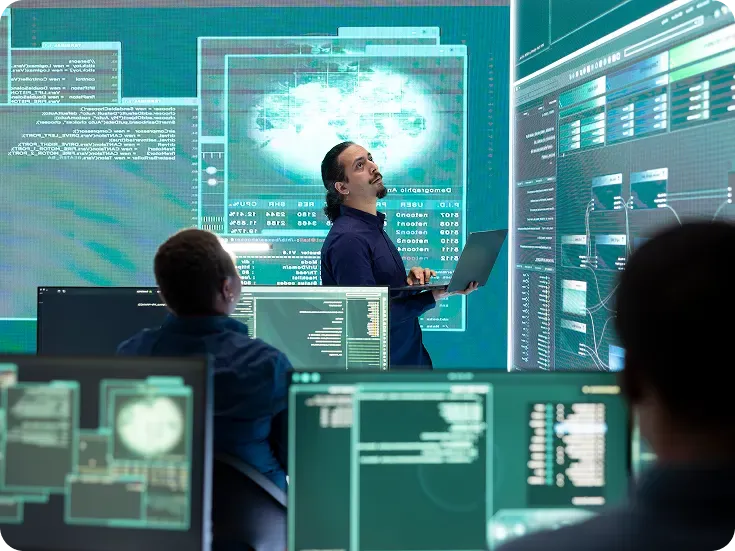
Most AI systems are built as one-time projects.
The problem usually isn’t the model itself. It’s the lack of a connected system behind it. Data pipelines, AI data annotation services, training workflows, and production systems are often disconnected, so the model never learns from real-world usage.
The AI Data Engine solves this by connecting data, labeling, training, and deployment into a continuous loop, so models can improve over time instead of stagnating after go-live.
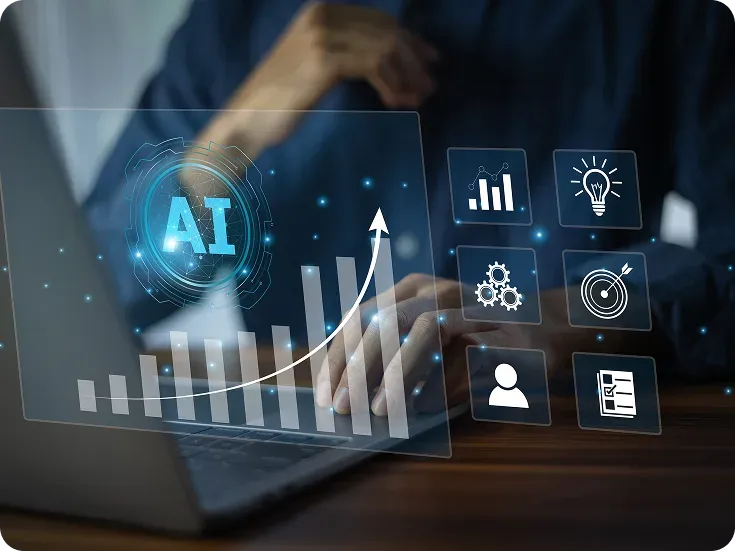
Our approach entails strong engineering judgment across the full system: what data to capture, how quality is measured, where feedback comes from, and how improvement happens after launch.
The system is designed with the full lifecycle in mind, so decisions about data, labeling, and retraining are aligned from the start.
Annotation, QA, and retraining decisions are driven by model behavior in production, not by volume alone or disconnected labeling targets.
Models are connected to real workflows, APIs, and review paths early, so the system learns from actual usage instead of staying isolated.
75% of clients stay 6+ years, and 80% of new work comes from referrals, evidence of systems that keep delivering over time.

A production-ready data pipeline and labeling system, including nearshore annotation, QA workflows, and validation tied directly to model performance.

A custom-trained model, benchmarked against strong baselines and integrated into real workflows, applications, or APIs where it drives measurable value.

A continuous learning system that captures errors, queues new data for labeling, retrains models, and monitors performance so accuracy improves over time.
Developing an AI data engine requires the right stack across data pipelines, annotation systems, model training, and production infrastructure to support continuous improvement. Our stack supports:
Pipelines that help manage data flow, trigger labeling jobs, and coordinate retraining workflows across the system.
Custom annotation tools and workflows combined with AI-assisted labeling to scale high-quality data annotation tied to model performance.
PyTorch, TensorFlow, and Hugging Face with MLflow or Weights & Biases to track experiments, benchmark, and support retraining.
Docker, Kubernetes, and cloud platforms with monitoring to deploy models, track performance drift, and support production.
This approach matters most when AI is part of an ongoing system rather than a one-time deliverable. If performance depends on new data, edge cases, human review, or changing real-world conditions, static models tend to fall behind. An AI data engine gives teams a way to keep improving accuracy, adapt to drift, and turn production usage into better model performance over time.
Inspection and detection systems in computer vision can fail on rare or evolving edge cases. A continuous labeling and retraining loop allows the model to learn from new scenarios and improve accuracy over time.
Invoices, contracts, and forms vary widely across sources. As formats and edge cases evolve, a static model falls behind. Continuous labeling and retraining keep accuracy stable at scale.
Search, recommendations, and automation features improve when they learn from real usage. Feedback loops allow models to adapt to user behavior instead of relying on static training data.
Fraud patterns and anomalies constantly change. Systems need continuous data ingestion, labeling, and retraining to stay effective and avoid performance drift.
Support, moderation, and operational review processes generate valuable labeled data. Capturing those decisions and feeding them back into the system reduces manual effort over time.





AI data pipelines move production data, errors, and edge cases into the workflows used for labeling, evaluation, and retraining. That makes it possible to improve models based on real usage instead of relying only on the original training set.
Model drift is handled by monitoring performance, identifying where outputs start to degrade, and feeding those cases back into labeling and retraining workflows. This helps the system adapt as data, user behavior, and real-world conditions change.
A one-time model training project usually falls short when the system has to keep learning from new data, support changing workflows, or maintain accuracy over time. That is when an AI data engine becomes more valuable than a static model deployment.
Continuous retraining requires data pipelines, AI data annotation workflows, model evaluation systems, and monitoring for performance and drift. These components work together to keep models accurate and reliable in production.
The most effective labeling comes from analyzing where the model is failing in production. Instead of labeling everything, high-impact AI data annotation focuses on edge cases, errors, and low-confidence outputs that directly affect performance.