





AI agents are worth understanding when they help produce real outcomes. The goal is not to chase hype, collect trendy tools, or confuse chat interfaces with engineering systems. The goal is to build solutions, reduce friction between idea and implementation, and use AI in a way that still respects infrastructure, scope, and technical boundaries.
Build range and depth
One of the easiest mistakes to make right now is to organize technical learning around whatever tool is getting the most attention this month. A better approach is to build broad working knowledge across the stack and then go deep in one area that compounds over time. Data is one of the strongest examples because analytics, machine learning, LLM systems, dashboards, and operational software all depend on reliable data foundations.
That matters because the real differentiator is not who can talk the most about AI. It is who can identify an opportunity, structure a solution, and deliver something useful. AI makes that difference more visible. It exposes who can build and who is still waiting for instructions.
What an agent actually does
A useful distinction here is the difference between chatting with an LLM and operating through an agent. A chat interface responds with text. An agent performs actions. The LLM handles reasoning, but the agent is the layer that takes those instructions and turns them into something concrete inside a real environment.
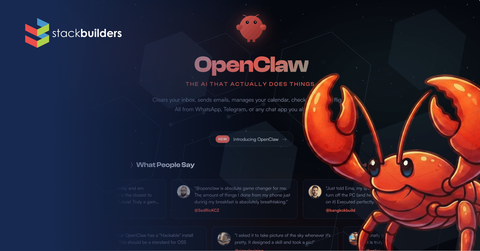
That is the role OpenClaw plays in this setup. A request such as “create a survey system” or “build a dashboard for CRM data” does not stop at a text answer. OpenClaw becomes the intermediary between the model and the server, allowing the agent to create files, organize folders, and produce something that can actually be reviewed in a browser or inspected in a workspace.
The lab setup
The environment used for this workflow runs on a VPS, with DigitalOcean used in the demo because it is easy to provision and inexpensive for short-lived practice.
You can read more about this information here. Please note that this guide is in Spanish.
Scope is part of the architecture
One of the most technical and most important ideas in this setup is that the agent works inside a constrained directory. The OpenClaw installation includes a workspace, and that workspace becomes the operating boundary. That boundary matters because once an agent can touch infrastructure, scope has to be treated as part of the architecture, not as an afterthought.
That means deciding where the agent can write, what user it runs as, which permissions it needs, and what happens when something goes wrong. If the system is not trustworthy anymore, the safest option is often to recreate it. Disposable infrastructure is not just a convenience here. It is part of the learning model and part of the control model.
Why this matters in delivery
This workflow becomes useful the moment requirements are vague. Sales teams, stakeholders, and even clients often arrive with an incomplete explanation of what they want, plus an Excel file with hundreds of rows and multiple tabs that no one has properly walked through. That creates rework because engineering starts from ambiguity.
Using an agent in this way helps land the idea earlier. Instead of leaving the meeting, building for several days, and returning with the wrong interpretation, it becomes possible to generate a working visual artifact during the conversation. That artifact can be reviewed immediately, challenged immediately, and refined while the problem is still being discussed.
Technical examples
A strong example from this setup is survey generation. One use case that Italo shared involved a pharmacy client that wanted to run surveys for international travelers at an airport. The original material contained a much larger set of questions in Excel, and the generated survey interface made it possible to discuss the structure, reduce the number of questions, and clarify the experience in the first meeting rather than later in the project lifecycle.
The surveys were not just static mockups. They included front-end behavior handled with vanilla JavaScript and enough UI polish to make the discussion concrete. That matters because the value was not in selling the generated survey as-is. The value was in accelerating alignment and making the requirement visible.
Italo also shared another example, which was a CRM-style interface with status movement, messaging behavior, and modular UI elements. Again, the point was not that the generated output was a production CRM. The point was that it gave a team something technical and visual to react to while the actual solution was still taking shape.
Data, search, analytics, and chat
One of the most technically interesting examples shown in the talk moved beyond interface generation. In that case, data had to be replicated from PostgreSQL into Elasticsearch, and dashboards then had to be built in Kibana. That already spans multiple layers of the stack: application data, search infrastructure, analytics tooling, and visualization.
Then the actual requirement became clearer. The dashboard was not the final goal. The real goal was to let an executive ask questions in chat and receive answers grounded in the analytical data. Instead of expecting someone to navigate Kibana, the system needed to expose analytics through a conversational interface that could answer questions like which salesperson sold the most.
That progression is a useful engineering reminder. A dashboard can look like the feature, but the real requirement may be faster access to decisions. The stack may begin with replication and visualization, but the business value may only become obvious when the data is exposed through a much simpler interface.
Cost and model selection matter
This setup also stays grounded in cost. API usage is not free, so prompt style, response length, and model choice affect how practical the system is to run. For the talk, GPT-5.4 mini was used because it was fast and inexpensive, which made it suitable for live experimentation.
That does not mean one model should do everything. OpenClaw can be connected to different providers, and model routing can be handled through tools such as OpenRouter so different kinds of tasks use different models. That is the right mindset for engineering teams. Reasoning, code generation, and lightweight utility tasks should be evaluated separately in terms of capability, latency, and token cost.
Better output requires better instructions
Another useful technical point is that interface quality is often a prompt design problem, not a mystery. The generated interfaces looked better because the operating instructions included requirements around modern and clean design, visual hierarchy, reusable components, responsiveness, accessibility, and code organization.
There is also an honest limit here. After enough projects, outputs start to converge. The first few may feel fresh, but eventually the same patterns begin to appear again. When that happens, the answer is not to blame the tool. The answer is to evolve the instructions so the design system, interaction model, or output constraints push the agent in a different direction.
What OpenClaw is good for
OpenClaw works well here as a personal or internal experimentation environment. It is useful for building ideas, testing workflows, generating technical artifacts, and learning how agents behave when they are attached to real infrastructure and real files.
That does not automatically make it the right shape for every customer-facing use case. If the real need is appointment scheduling, client-facing automation, or a narrow workflow in production, the better path is often to learn from this environment and then build a more specific system with tighter controls, clearer domain boundaries, and implementation choices made for that exact problem.
Conclusion
AI agents are most useful when they are treated as execution layers inside engineered boundaries. That means infrastructure still matters, permissions still matter, file structure still matters, and generated code still has to be reviewed by someone who understands the system around it.
The gain is speed. A well-scoped agent can shorten the distance between discussion and implementation, make vague requirements visible sooner, and give engineering teams a faster path to the real problem. That is where this becomes practical for backend and full-stack developers: not as a replacement for architecture or judgment, but as a way to move through discovery and prototyping with much more momentum.
Learn more about Ítalo Morales on LinkedIn.