
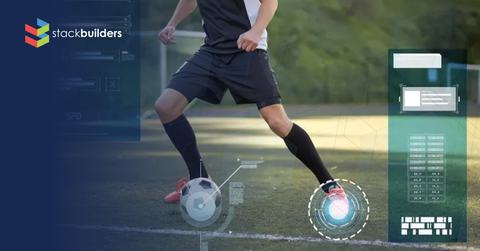





The 2026 FIFA World Cup is putting computer vision in sports in front of more people than any product demo ever could. Millions of viewers are watching a ball feed data to referees, cameras track offside lines in real time, and (a few months later) baseball adopt its own version of automated officiating. None of it will look like "AI." It will just look like sports, working a little better than before.
That's exactly why it's worth studying. For technology and product leaders evaluating whether computer vision is worth exploring in their own organization, the World Cup is a useful, low-stakes case study in what good looks like, and what it doesn't.
The Ball That Feeds the System
The official 2026 World Cup ball, the Adidas Trionda, is built around Connected Ball Technology: a motion sensor inside the ball that captures data up to 500 times per second, precise enough to flag the exact instant a player makes contact. That data is combined with a multi-camera tracking system covering the pitch, creating a detailed digital record of the match as it happens.
Here's the part that matters for a business audience: the ball doesn't make calls. It generates high-frequency, structured data that feeds officiating systems and semi-automated offside technology (SAOT), the AI-powered computer vision FIFA has used since the 2022 World Cup to track players and the ball. A human official still reviews the output before a decision is made. The technology's job is narrow and specific: capture the moment of contact with more precision than the human eye can, and hand that information to the people who make the call.
That's the pattern worth noticing. AI-powered computer vision earns its place in a high-pressure workflow by improving the quality of the evidence available, not by replacing the judgment applied to it.
Baseball Is Taking the Same Approach
Major League Baseball is rolling out its Automated Ball-Strike Challenge System for the 2026 season, using Hawk-Eye tracking to let players and managers challenge a limited number of calls per game. It's not full automation. Umpires stay on the field, and the technology only steps in when someone asks for a second look on a specific pitch.
Two very different sports, and the same underlying decision: use computer vision to support a bottleneck, not to remove the people managing it. That's a deliberate, business-minded choice, not a technical limitation. Full automation was available to both organizations. They chose a narrower, validated application instead because the cost of a wrong call made by an unchecked system was higher than the cost of a slightly slower human-in-the-loop process.
This Isn't a Niche Experiment Anymore
AI in the World Cup and other major sporting events tends to draw attention because of the moment, but the underlying market is already substantial: the AI in sports market is valued at roughly $9.8 billion in 2026 and is projected to reach approximately $50.7 billion by 2033, a compound annual growth rate of nearly 26.5%. Now, let's be clear, that's not a signal that every organization needs a computer vision strategy by next quarter. It's a signal that the tooling, the talent, and the proof points have matured enough that "computer vision in sports" is no longer an emerging idea. It's an operating assumption in an industry that depends on speed and accuracy under pressure, which describes a lot more businesses than just sports leagues.
What This Means If You're Not Running a Stadium
Most organizations outside of sports have their own version of the offside call: a moment where a person has to review an image or a clip and make a judgment quickly, consistently, and under some kind of pressure:
- Manufacturing teams doing visual quality inspection.
- Operations teams reviewing safety footage.
- Field teams documenting site conditions.
Any workflow where someone is looking at the same category of visual information over and over, and the review is slow, inconsistent between reviewers, or eating more staff time than it should.
That's the actual signal to look for, not "we should have an AI vision strategy" as a general ambition. Computer vision is worth exploring when there's a specific, high-volume, image- or video-heavy workflow where better or faster visual data would change an outcome your business already cares about. And honestly, it's common across more industries than you might think.
Start With the Process, Not the Model
The World Cup examples share a structure worth borrowing directly: define the specific decision that needs support, build the narrowest system that can meaningfully improve it, and keep a human checkpoint until the system has proven itself under real conditions. FIFA didn't deploy SAOT across every possible officiating decision on day one. It validated the technology, refined it, and expanded from there.
Before investing in a broader computer vision initiative, it's worth answering a few questions honestly: Which process is costing the most in manual review time or inconsistent outcomes? Do you have, or can you reasonably collect, the image or video data that reflects real operating conditions, not just ideal ones? And if a pilot proves the concept, is there a clear owner and path to production, or will it sit as a demo?
Prove It Before You Scale It
Computer vision in sports is having a very visible moment in 2026, and it's a good one to learn from precisely because the organizations behind it are being disciplined about where AI vision fits and where human judgment still leads. That's the model worth applying to your own business: identify the one workflow where visual review is genuinely slowing your team down, validate a working pilot against real conditions, and only then decide what scaling looks like.
If you're trying to figure out where computer vision might create measurable value in your operations, we'd be glad to talk through it. Reach out to Stack Builders to discuss your workflow and what a focused, validated pilot could look like.
Related reading: Computer Vision in Finance: Scaling Manual Review and more insights from the Stack Builders team.